Imperial Porcelain House
The Collections
Four patterns the factory is known by, and what separates them.

Anna Yatskevich, 1944 · gold medal, Brussels 1958
Cobalt Net
The factory’s most famous collection. Its history begins in 1944, when the artist Anna Yatskevich drew the pattern that would become the emblem of the manufactory.
Several accounts of its origin exist. One traces it to the first Russian porcelain service of the eighteenth century, made for Empress Elizabeth Petrovna. Another, more poetic and far better known, sees in the diagonals the paper crosses taped over the windows of besieged Leningrad and the beams of searchlights in the night sky.
However it began, the drawing proved so successful that in 1958 it took a gold medal at the Brussels World’s Fair, and has been an emblem of Russian porcelain ever since.

Bone china · elegance without decoration
White Gold
The calmest and most patrician of the factory’s collections. There is no elaborate ornament and no painted decoration here: the porcelain itself does the work — a thin, translucent bone china body that seems to glow from within when held to the light. Its only addition is a fine band of gold, laid on by hand.
The restraint is deliberate. It continues the tradition of European and Russian ceremonial porcelain, in which the true ornament was never the drawing but the perfection of the form, the whiteness of the material and the luster of the gold.

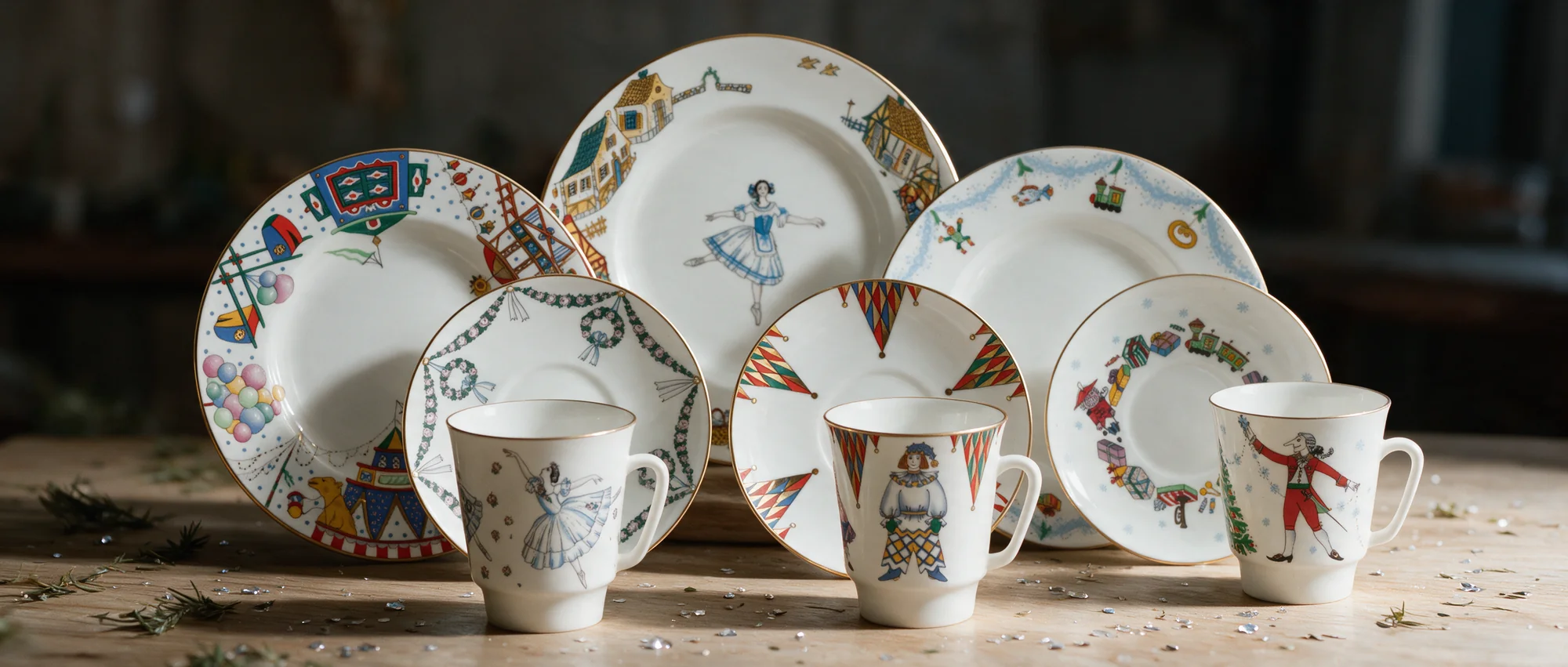
Hand-painted · Swan Lake, The Nutcracker, The Sleeping Beauty
Ballet
Ballet tells an altogether different story. Russian ballet has long been one of the country’s calling cards, and the artists of the factory set out to carry that atmosphere onto porcelain, taking the legendary productions as their point of departure.
Rather than reproduce the scenes literally, they convey the sensation of the theater itself: the lightness of a tutu, the movement of the dance, the play of light on stage, the festive weight of the curtain. Each piece reads less as tableware than as a small stage set.
The Nutcracker pieces land differently on an American table. George Balanchine staged the ballet in New York in 1954 and turned it into a Christmas fixture, so a family that has gone every December is buying a scene it already knows by heart.

Yulia Chistyakova · a rococo lattice reimagined
Scarlet
If Cobalt Net is the classic, Scarlet shows how a tradition can be rethought. The artist Yulia Chistyakova kept the structure of the old geometric ornament, drawn from the decorative lattices of the rococo, but brought in warm reds and gold stars.
The result keeps its link to the history of the Imperial Porcelain Factory while taking on a more contemporary, more emotional character — an example of how a heritage almost three centuries old continues to develop without losing what makes it recognizable.